QIS Group
Ninnat Dangniam (PI) · Quantum Information Science, Institute for Fundamental Study (IF), Naresuan University
Research
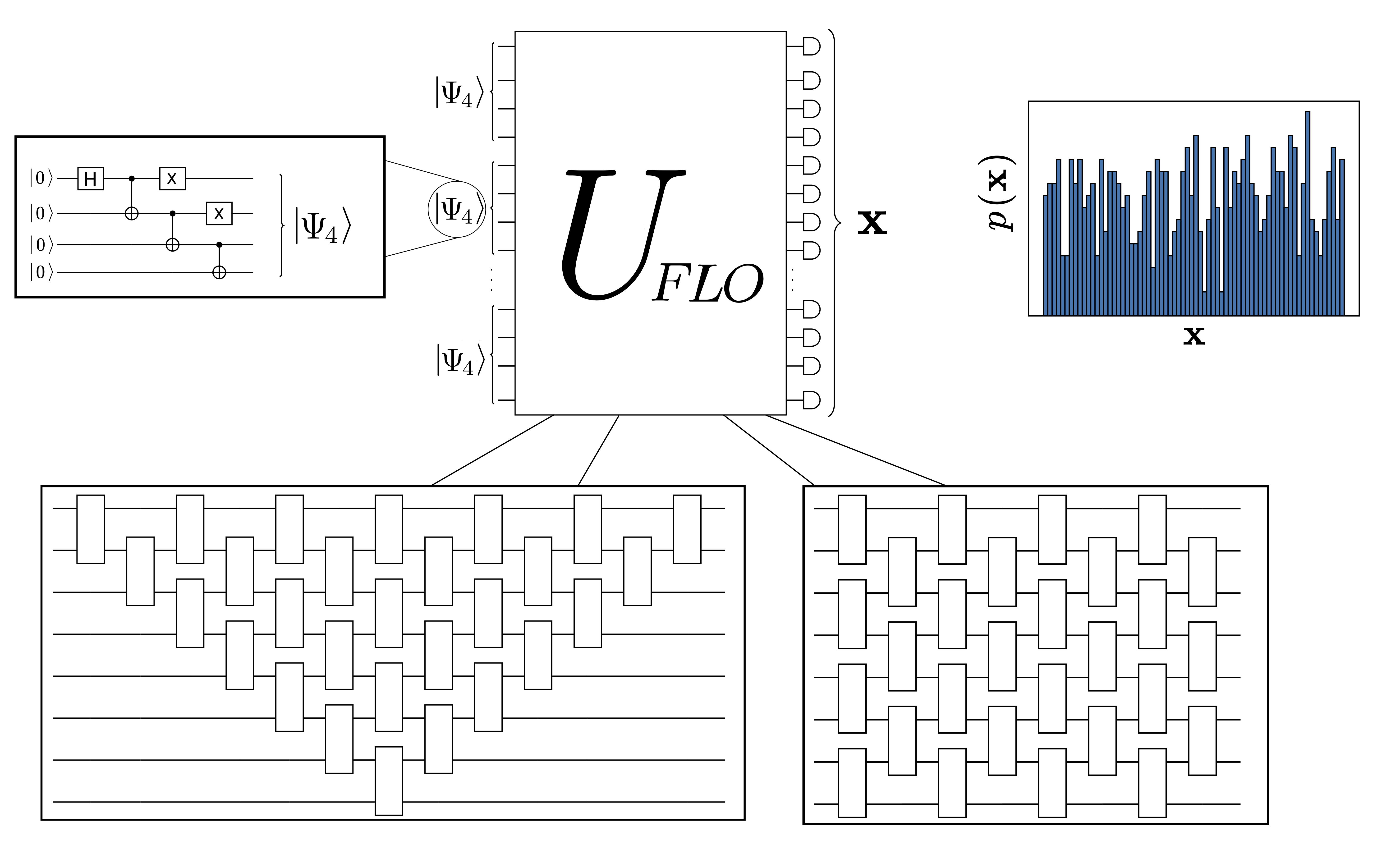
Quantum computational advantage
Sampling advantage Fermionic linear optics Driven many-body systems Variational quantum circuits Phase transitions
How do you show that an information-processing device is doing something beyond classical reach? We build sampling-based advantage schemes—proposals in which a quantum device produces an output distribution provably hard to reproduce classically. One of them, Fermion Sampling, carries average-case hardness guarantees on the same footing as random circuit sampling, and can be certified indirectly, by efficiently learning the fermionic-linear-optical circuit that produced the output samples. We also ask what anti-concentration, a necessary ingredient of such proof, implies about expressivity and trainability of variational quantum models.
Talk slides: Quantum sampling advantage: How to prove it and does it matter? (2023)
- J. Tangpanitanon et al., Signatures of a sampling quantum advantage in driven quantum many-body systems, Quantum Science and Technology 8, 025019 (2023).
- M. Oszmaniec, N. Dangniam, M. E. S. Morales and Z. Zimborás, Fermion sampling: A robust quantum computational advantage scheme using fermionic linear optics and magic input states, PRX Quantum 3, 020328 (2022).
- S. Thanasilp et al., Quantum supremacy and quantum phase transitions, Physical Review B 103, 165132 (2021).
- J. Tangpanitanon et al., Expressibility and trainability of parametrized analog quantum systems for machine learning applications, Physical Review Research 2, 043364 (2020).
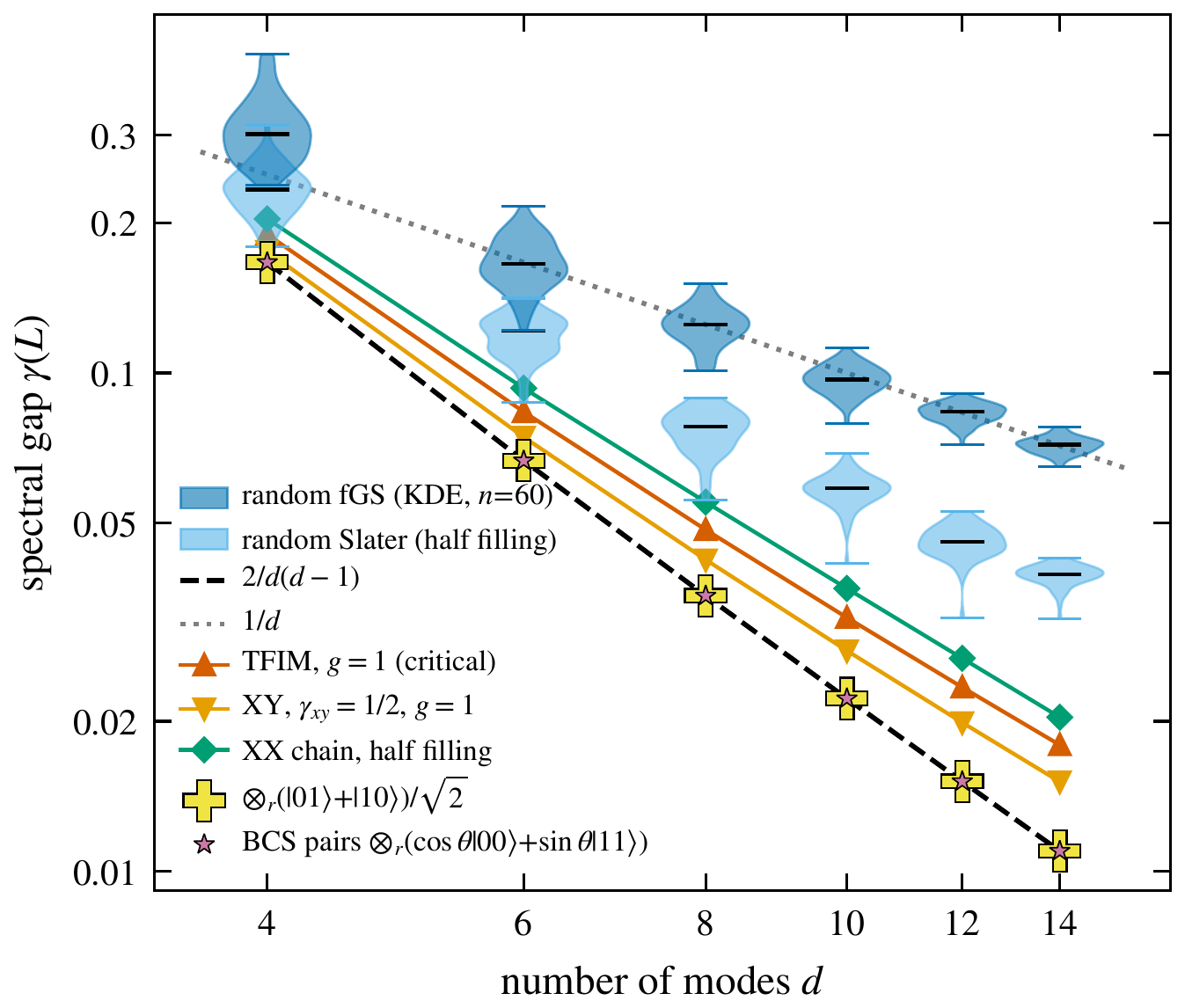
Quantum estimation and certification
Quantum tomography Certification Stabilizer states Fermionic Gaussian states Markov chains
With the potential of quantum information processing comes the challenge of verifying that the quantum devices indeed give the correct results. We design measurement strategies and estimators that pin down a state or a process from as few copies and as few trusted assumptions as possible, with provable guarantees on how the sample cost scales. Our recent work certifies fermionic Gaussian states, important reference states for quantum simulations of electronic structure and many-body physics, in a highly efficient manner.
- N. Dangniam, L. Premcharoen, M. Sripech and T. Chotibut, Certifying fermionic Gaussian states (and a little more) with optimal precision dependence, arXiv:2609.28233 (2026).
- M. Oszmaniec, N. Dangniam, M. E. S. Morales and Z. Zimborás, Fermion sampling: A robust quantum computational advantage scheme using fermionic linear optics and magic input states, PRX Quantum 3, 020328 (2022).
- N. Dangniam, Y-G. Han and H. Zhu, Optimal verification of stabilizer states, Physical Review Research 2, 043323 (2020).
- J. A. Gross, N. Dangniam, C. Ferrie and C. M. Caves, Novelty, efficacy, and significance of weak measurements for quantum tomography, Physical Review A 92, 062133 (2015).
The complete publication list is on Google Scholar.
Students
Current
Laphas Premcharoen Ph.D.
QTFT scholar
Metrasit Sripech M.S.
NU scholar
Past
Matachan Oupatam M.S.
DPST scholar · Thesis: Evaluating quantum state verification for \(d\)-level graph states (2026)